
How to Set Strength Training Goals That Fit Your Life
What are your strength training goals? A new squat PR, your first competition, or just feeling stronger and more capable in everyday life?
Picking a target is one thing. Setting yourself up for success so you actually stick with it long enough to get the result is another.
One of the tools I use with my coaching clients is a Goal Hierarchy. It’s a way to connect your bigger reasons for wanting to reach these goals with the everyday, practical things you need to do to support them. It helps you place your strength training goals in the wider context of your life and values.
What makes a useful strength training goal?
There’s nothing wrong with wanting to squat 150 kg, pull a 200 kg deadlift, improve your powerlifting total or finally manage a pull-up. Having a target can make training more enjoyable and give you something specific to work towards.
The trouble comes when the number or deadline becomes the whole goal. You can do everything well and still not hit a particular lift by the date you picked, or you may meet the goal much earlier and be left wondering what comes next. Strength progress isn’t always linear, but our training habits need to be consistent to get there.
I find it more useful to separate two things:
- Outcome goals: what you want to achieve, such as a new PR, completing a competition or getting stronger at a particular lift.
- Process goals: what you’re going to do to give yourself the best chance of achieving it, such as completing three sessions a week, practising your technique or making time to recover.
The outcome points you in a direction. The process is what actually gets you there. Without direction, we’re driving in circles, but without a process, we’re just idling at the start line.
Why is it hard to stick to training goals?
You might be familiar with setting an ambitious New Year’s resolution, making a strong start and then watching it slide as life gets busy.
It’s tempting to blame a lack of motivation. But quite often the problem is that the goal has no personal connection or value behind it. It might be something you feel you should want rather than something you really care about. Or it might be something you do care about but haven’t fully worked out why it matters to you, so it feels disconnected from the things that drive you to action.
Say you’ve written ‘go to the gym three times a week’ in your calendar. On a busy Tuesday, that’s just another appointment you could cancel. It’s easier to see why the time matters when you remember that training is one of the things you do to stay physically capable, enjoy your sport or keep doing the activities you love as you get older.
That’s what a Goal Hierarchy helps you do. It gives the day-to-day tasks a connection to the bigger picture.
And yes, ‘because I enjoy lifting weights’ is a perfectly good reason to train. Your goals don’t all have to serve some grander performance or health objective.
What is a Goal Hierarchy?
Think of a Goal Hierarchy as a flowchart connecting your values to the actions you take each day. I use four levels:
- Values and ‘whys’: what you really care about. Maybe that’s being physically capable, enjoying challenging yourself, or having more energy for people and activities that matter to you.
- Superordinate goals: broad aims that support those values, such as improving your health, becoming a stronger athlete or being more active.
- Intermediate goals: the parts of those aims you want to work on, such as developing strength, training consistently, improving nutrition or getting more sleep.
- Subordinate goals: specific things you can actually do, such as following your three-day training program this week, packing your gym bag or setting a regular bedtime.
This framework allows us to look at something you’re doing today and see why it’s worth doing.
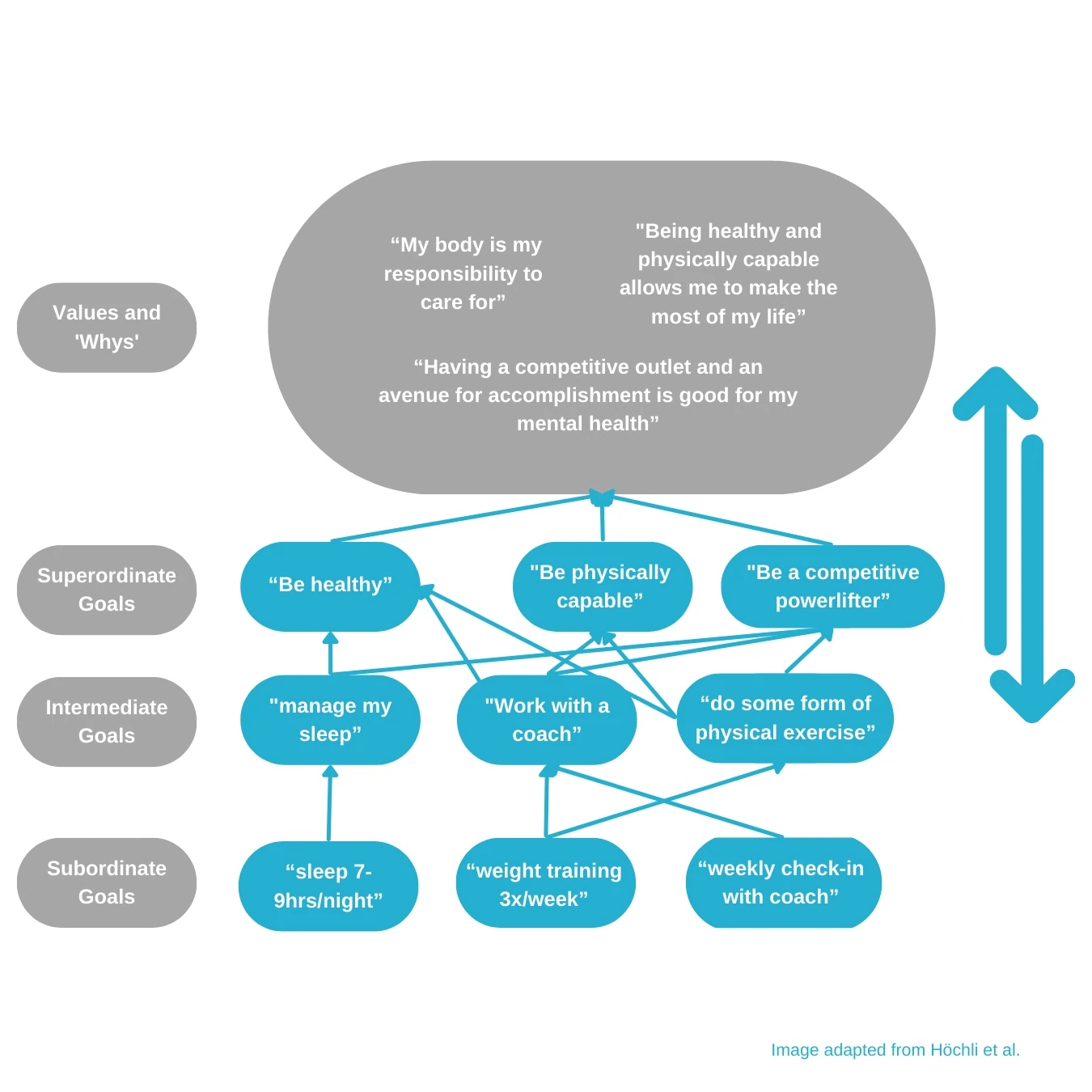
An example for strength training
Let’s say one of your bigger values is staying physically capable and making the most of life as you get older.
That might lead to a broad goal of maintaining your health and fitness, with strength training, nutrition and sleep as different areas you want to work on.
Under strength training, your practical actions might be to train three times a week, follow the same program long enough to learn from it and gradually work towards being stronger across a few lifts.
Now imagine that you also enjoy powerlifting and want to compete. Those same training sessions can support both aims: staying capable in everyday life and becoming a better powerlifter.
This is an important feature of the hierarchy. One action can support several goals, and one goal can be supported by several different actions. The actions you take are integrated, and a change in one aspect of your life doesn’t mean you have to abandon your overall goals.
How do you create your own Goal Hierarchy?
You don’t need an app or an elaborate spreadsheet. I find a pencil and paper, or a handful of post-it notes, works very well. You’ll probably move a few things around as you go.
1. Write down your goals
Start by listing everything that comes to mind. Include the lifts you’d like to improve, events you want to do, aspects of your health or fitness that matter to you and the habits you think would help.
Don’t worry yet about which level of the Goal Hierarchy each thing belongs on. Just get your ideas down.
2. Ask yourself why each one matters
Go through the list and ask: Why do I want this? Why do I care whether it happens?
If you want a new deadlift PR, maybe it’s because you enjoy having a difficult challenge to work towards. If you want to train more regularly, perhaps you want to stay strong enough to do the things you enjoy outside the gym.
You can keep asking why until you reach something that feels genuinely important. Sometimes that will lead to another goal already on your list. Sometimes it will help you recognise a value or higher-level goal you hadn’t really put into words before.
If an answer doesn’t come easily, move on and come back to it. You don’t need to invent a profound reason for everything.
3. Separate the things you want from the things you can do
Go back through the list and ask which goals are actions you can physically carry out.
‘Improve my sleep’ is an area to work on, not a task you can complete tonight. ‘Start winding down at 10 pm’ is something you can actually do.
The same applies to strength. ‘Get a stronger squat’ is an outcome. ‘Complete my planned squat sessions and record the weights, reps and effort’ is an action.
Put those actionable goals at the bottom. They become your subordinate goals.
4. Connect the levels
Put your values and big reasons at the top. Arrange the broader and more specific goals between those values and your practical actions, then draw the connections.
Some goals could reasonably sit at more than one level. That’s fine. This isn’t an exam where you have to get the categories exactly right. Just put it where you think it fits best.
What is useful is noticing gaps. Do you have a big goal with nothing underneath it that you’re doing to support it? Or a weekly activity that doesn’t seem to connect to anything you care about? You don’t have to fill or close every gap on your first pass of the Goal Hierarchy. You can come back to them over time.
5. Make the actions fit your actual week
A goal is only useful if you have a realistic way of working towards it.
If your training plan requires five two-hour sessions every week but you reliably have time for three, start with three. You can always adjust later. A program that fits your life and gets done consistently is much more valuable than one that looks impressive on paper and falls apart after the second week.
Think about the likely barriers as well. What happens when work runs late, you travel or your normal training time disappears? Can you move a session, shorten it or adjust the week without giving up on the whole plan? This builds some resilience into your system.
You might not get this right immediately. Try it, see what gets in the way and revise it.
Should you focus on PRs or process goals?
I like PRs. They’re fun to chase, and improving a lift can be a useful way to see whether the training is working.
But a PR is an outcome. You can’t directly control when it happens. What you can control is how you train, how consistently you show up and whether you make sensible decisions when issues or necessary changes arise.
For example, if you want to improve your bench press over the next few months, useful process goals might be to:
- Complete your planned bench sessions most weeks.
- Use the prescribed intensity rather than trying to max out every session.
- Film some working sets so you can review your technique.
- Record your training data consistently enough to spot a trend.
- Stick with the program all the way through before jumping ship.
You can still keep the bigger bench goal in mind. The point is to judge your day-to-day success mainly by the actions you took, not whether a new number appeared on the bar this week.
And not every PR needs to be a competition-style one-rep max. A rep PR or progress in a different lift might be exactly what’s useful for the training you’re doing now. Better technique can be worthwhile progress, too.
What if you miss sessions or your goals change?
At some point, your training probably won’t go entirely to plan. That’s normal when it has to fit around work, family, sleep and the rest of life.
This is another reason I like the Goal Hierarchy. If you miss a session but still make useful progress with your sleep or nutrition, you haven’t necessarily abandoned the bigger aim of getting healthier or supporting your training. You have more than one way of moving towards what matters.
It can also help when a goal changes. Maybe you were preparing for a powerlifting competition and the date no longer works. You might still want to get stronger, enjoy training and build muscle, even if competing isn’t the end goal for now.
You can go back up the hierarchy and ask which bigger goals still matter, then change the intermediate goals and daily actions to suit.
If the same unavoidable barrier keeps getting in your way, don’t just promise yourself you’ll try harder next week. Work out whether you need a different schedule, a more manageable plan or some support from someone who can help you with that barrier or troubleshoot a solution.
Progress comes from doing most of the work, most of the time, over the long term. The goal isn’t to construct a plan you’ll follow perfectly forever. It’s to build something useful, keep learning from it and adjust as you go.
How does coaching help with pursuing these goals?
You should now have everything you need to build a Goal Hierarchy and use it to organise and support your own training.
Where coaching can help is with the decisions underneath those goals. Once we’ve worked out what matters to you, I can build your program around your priorities and the time you actually have, review your training and lift videos, and help you adjust the plan when your progress or circumstances change. This can relieve you of some of the cognitive burden or add accountability, which can be especially valuable if those are barriers for you.
We can make training something that supports the rest of your life, while helping you strive towards your strength goals.